 English
 Indonesia

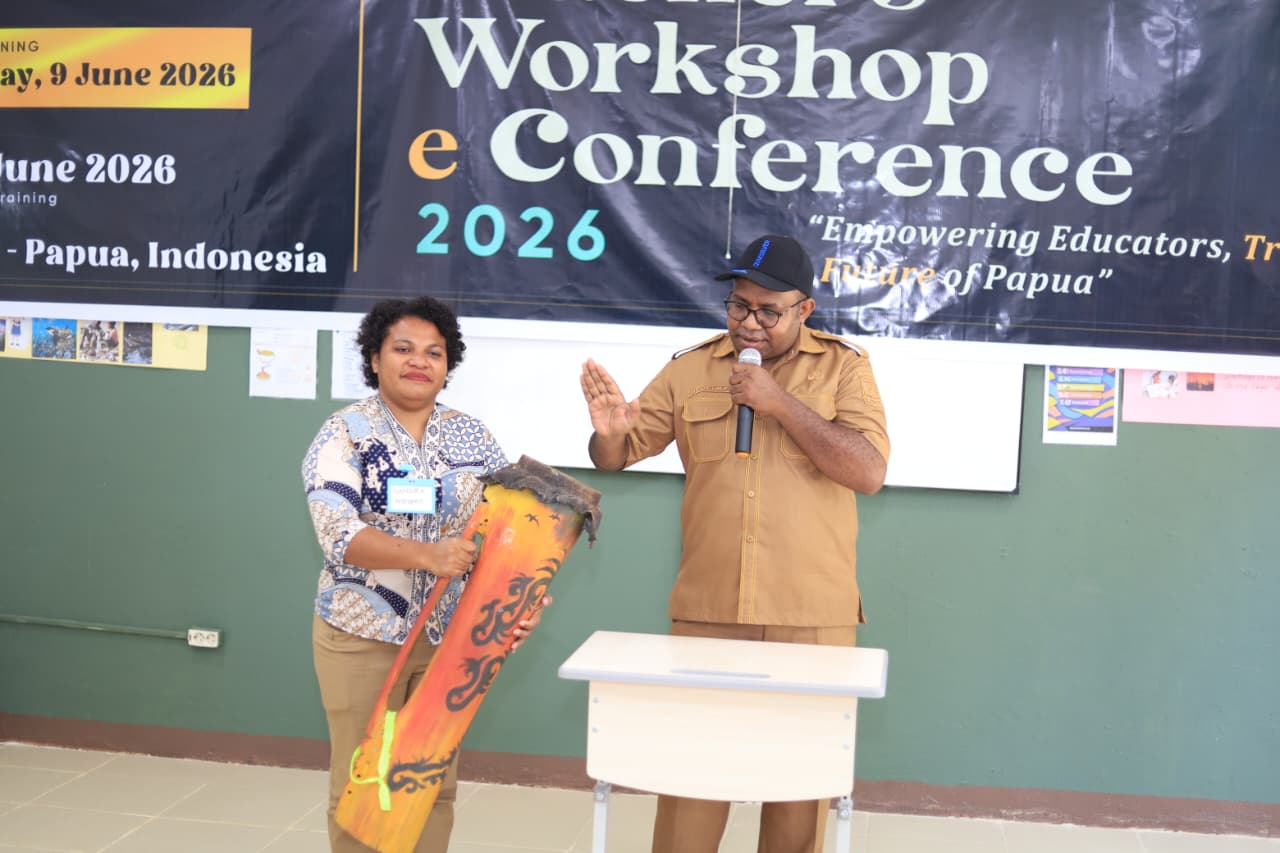
NABIRE — The Education and Culture Office of Central Papua
Province opened a Teachers Workshop / Conference for English teachers of the
Black Pearl English Course (BPEC) at the head office of the Black Pearl Papua
Foundation (Yayasan Mutiara Hitam Papua) on Jalan Yan Mamoribo, Sanoba, Nabire,
on the morning of Tuesday, 9 June 2026. Organised by the Black Pearl Papua
Foundation together with the Black Pearl Network (Australia), the event was
attended by teachers from 17 centres spread across six provinces in the Land of
Papua.
The teachers had travelled distances that are not easily covered. Many of
them teach in areas with patchy mobile signal, winding roads, and minimal
facilities. Yet they keep coming, keep teaching, and keep believing that a
single English word taught today can open a door to the future tomorrow. They
came not for themselves, but for the students waiting back in their home
villages. The workshop exists to nurture that spirit — so that the teachers do
not feel they are walking alone, and so that the flame they carry into remote
classrooms is not extinguished.
The name “Mutiara Hitam” — Black Pearl — that the foundation bears is
more than a symbol. It is a way of seeing every Papuan child: as a precious
pearl, waiting to be found, cared for, and allowed to shine. And this morning,
those who tend to these pearls — the teachers — sat side by side, from the
mountain highlands to the coastal shores.
The warmth was felt from the moment the representatives of the Black
Pearl Network (BPN) Australia, Ross Gobby and Geoff Schupp, arrived in person
among the teachers. On behalf of the partner network from across the seas,
Geoff Schupp opened the series of remarks in a voice that was gentle yet
stirring. He recounted that this annual conference was born of a long
partnership — a commitment not merely to run a program, but to keep
accompanying and developing the teachers in the Land of Papua. He extended his thanks
to Mina and Lena, and to all who had worked hard to prepare the morning.
Then, his eyes sweeping across the room, he said, “The things you do
truly amaze us back in Australia.” He affirmed that, though separated by
thousands of kilometres, his side felt part of every classroom in the remote
corners of Papua. “We think about you, we pray about you, and we support you as
we go forward.” The words lingered for a moment in the air, and several
teachers were seen bowing their heads, holding back tears. He also praised
those who move fluently from their local language, to Indonesian, then to
English — an intelligence that, he said, humbled him. Before closing, he left
behind one line that stayed with the audience: “The greatest weapon you have
for the future is your education. There is nothing more powerful than that.”
After the remarks from the Australian partner, the long-awaited moment
arrived: the Education and Culture Office of Central Papua Province officially
opened the event, represented by Meldeky Anouw. Inviting the office to open the
workshop was no mere formality. For the Black Pearl Papua Foundation, it was a
mark of honour to a strategic partner that for the past two years has walked
alongside it in English-language programs — in the regencies of Timika, Paniai,
and Nabire. That partnership is itself a tangible expression of the Governor of
Central Papua’s commitment to the future of Papuan children.
Representing the office, Meldeky Anouw began with gratitude and sincere
appreciation to the Black Pearl Papua Foundation. This cooperation, he said,
was not the first; it had been established since last year, and his first
meeting with one of the partner representatives from Australia even took place
at the Governor’s Office. This morning, in a building that had only just been
completed, he witnessed a dream beginning to stand tall.
For Meldeky, English is not merely a school subject. It is a window to
the world — a door that can carry Papuan children to study abroad, and a means
for them to possess genuine competitiveness. He envisioned a young Papuan
generation able not only to work in their homeland, but to stand as equals at
the national and international levels, and one day even to master Mandarin and
Japanese. That hope, he said, is not without urgency: starting in 2027, the
central government will require English instruction from grade 3 or 4 of
elementary school. So Central Papua chooses to prepare early — not to wait, but
to seize that future from now.
Yet amid all those grand hopes, he conveyed the most touching point of
all. The key to children’s success in the classroom, he said, lies largely in
the hands of the teacher. He touched on a wound that is often hidden — many
Papuan children feel insecure, especially because English is not their mother
tongue. The teacher’s task, he said, is to build their courage to speak, to
appreciate every mistake without laughing at it, and to guide them until they
are able. “We cannot work alone,” he said softly — an admission that a dream
this large can only be held together. In the participants’ seats, more than a
few fell silent, then nodded. They recognised themselves in those words:
teachers who are weary, yet have never truly given up.
This morning, that hope stretched far. The Central Papua provincial
government wants English learning not to stop in cities like Nabire and Timika,
but to reach into the interior — Paniai, Dogiyai, Deiyai, Intan Jaya, and
Puncak. That is why the choice fell on the teachers: rather than merely
training students for a few months, they train the teachers, for from the hands
of a trained teacher, hope will live on long after the training ends. The
training runs for ten days, from 8 to 17 June 2026.
When the event was officially opened this morning, what truly began was
not merely a workshop. What began was a new chapter of hope — that in this rich
land, its finest pearls, its children, will continue to be guarded by the hands
of teachers who love them. And this morning, in Sanoba, those hands clasped one
another, ready to walk home carrying a brighter flame.

Add New Comment