 English
 Indonesia

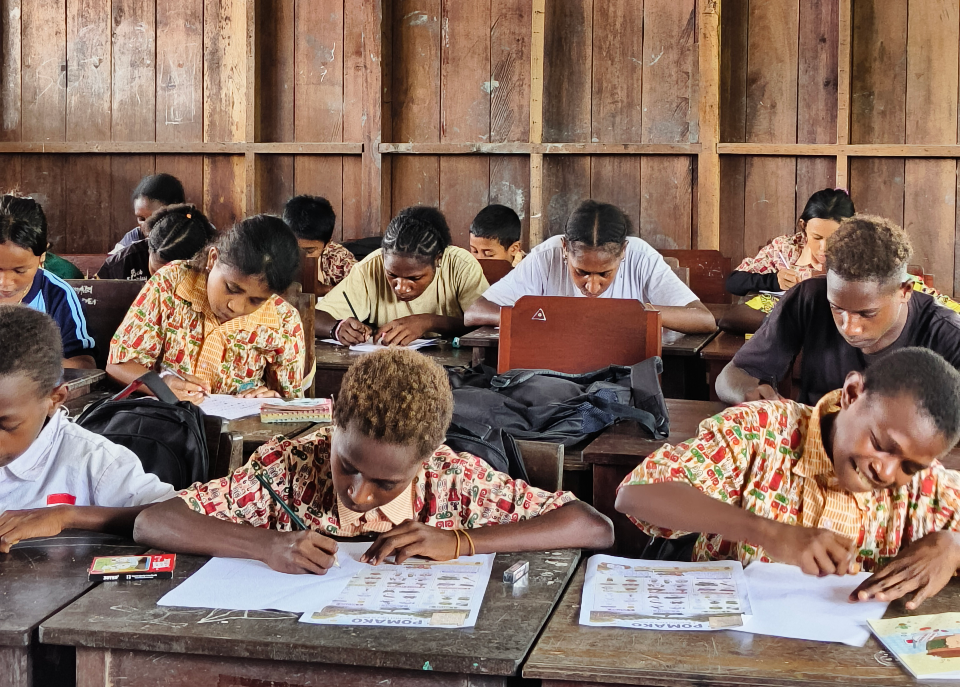
Now in its second year, the Black Pearl English Course reached
1,100 Indigenous Papuan students from 12 schools in Mimika, Paniai, and Nabire
regencies, with full funding support from the Central Papua Provincial
Government.
YMH Papua Bulletin Editorial Team
• Central Papua
NABIRE — The English-language
training program for Indigenous Papuan students (Orang Asli Papua / OAP)
organized by the Mutiara Hitam Papua Foundation (YMH Papua) has now entered its
second year. Known as the Black Pearl English Course (BPEC), the program
has been running for two consecutive years — throughout 2025 and 2026 — serving
students from elementary through senior high and vocational levels in Central
Papua.
This year, the training was conducted across three regencies — Mimika,
Paniai, and Nabire — and was attended by a total of 1,100 Indigenous
Papuan students from 12 schools. This broader reach gave many more Papuan
children the chance to benefit from the program.
Notably, this year's program received full funding support from the
Central Papua Provincial Government under the leadership of Governor Meky
Fritz Nawipa, S.H. The support was channeled through the Central Papua
Education and Culture Office (Dinas Pendidikan dan Kebudayaan), marking the
regional government's strong commitment to advancing the education of
Indigenous Papuan children.
That commitment is seen as being in line with the “Papua Tengah
Terang” (A Bright Central Papua) vision, which places education at the
heart of the region's development. This year's program ran for 15 days, from 11
to 25 May 2026, with participants guided by professional tutors following a
curriculum aligned with BPEC standards.
Participant and School Distribution by Regency
This data on student distribution covers 12 schools spread across three regencies, namely Mimika, Paniai, and Nabire, with a grand total of 1,100 students.
In Mimika Regency, there are five schools with a total of 388 students. At the elementary level, SD Negeri Satap Pomako I has 100 students and SD YPPK Tillemans Mware has 44 students. At the junior high level, SMP Negeri Satap Pomako accommodates 95 students and SMP YPK Ebenhaezer accommodates 85 students. Meanwhile, at the vocational high school level, SMK Negeri 5 Kemaritiman Mimika has 64 students.
In Paniai Regency, there are four schools with a total of 611 students, which is the highest number among the three regencies. At the elementary level, SD YPPGI Enarotali has 129 students. At the junior high level, SMP YPPGI Enarotali accommodates 283 students and SMP YPPGI Kefas accommodates 68 students. At the vocational high school level, SMK Negeri 1 Pariwisata has 131 students.
In Nabire Regency, there are three schools with a total of 101 students, which is the lowest number. These schools include SD Negeri Uwapo with 21 students, SMP Negeri 1 Uwapa with 52 students, and SMA Negeri 7 Nabire with 28 students.
Overall, among the three regencies, Paniai contributes the largest number of students (611 students), followed by Mimika (388 students), and Nabire (101 students), bringing the total to 1,100 students across 12 schools.
An Interactive Curriculum for Elementary to High School
The material covered basic grammar, vocabulary building, conversation and
speaking practice, listening comprehension, reading and storytelling, simple
writing practice, and a cultural exchange session. The learning method was
designed to be interactive, participatory, and contextual — combining theory,
hands-on practice, educational games, and group discussions to keep the
atmosphere enjoyable and easy for participants to absorb.
Encouraging Results
The results were considered encouraging. Participants were able to
introduce themselves and hold basic conversations in English, with vocabulary
increasing significantly — an average of 200 to 300 new words per participant.
Participants' confidence in speaking before an audience also grew, supported by very high attendance throughout the training. Just as importantly, the program nurtured participants' motivation to pursue higher education, including interest in LPDP scholarships and overseas scholarships.
“Never stop learning. English is merely a door — your future
lies in your own hands. Always be proud as Indigenous Papuans, and carry the
good name of the land of Papua to the world stage.”
— Mina V Sarwom, Chairman of the
Mutiara Hitam Papua Foundation
YMH Papua Chairman Mina V sarwompraised the participants' enthusiasm for
learning. He described them as “the black pearls of Papua who will shine in
the future,” and expressed his hope that the knowledge they gained would
continue to be practiced, developed, and shared with friends in their
respective communities.
Synergy of Government, Church, and
International Partners
Beyond the full funding from the Central Papua Provincial Government
through the Education and Culture Office, the program's continuity is also
sustained by cross-border and church partnerships. Black Pearl Network
Australia and the Uniting Church in Australia Synod of Western Australia
contribute to curriculum development and international partnership, while the
Evangelical Christian Church (GKI) in the Land of Papua serves as a strategic
partner in ministry to the Papuan community.
Challenges and Hopes
Behind its achievements, the organizers noted several challenges for
improvement, including limited learning facilities and infrastructure, the
varied initial ability levels among participants, the need for more adequate
guidebooks and printed materials, and the need for a longer training duration
so that learning outcomes can be more optimal.
With the regional government's growing support, YMH Papua reaffirmed its
commitment to continue running similar programs together with its partners, the
government, the church, and the community. “Let us together build a Papua
that is empowered, cultured, and ready to compete on the world stage,” as
the hope expressed by the foundation.

Add New Comment